
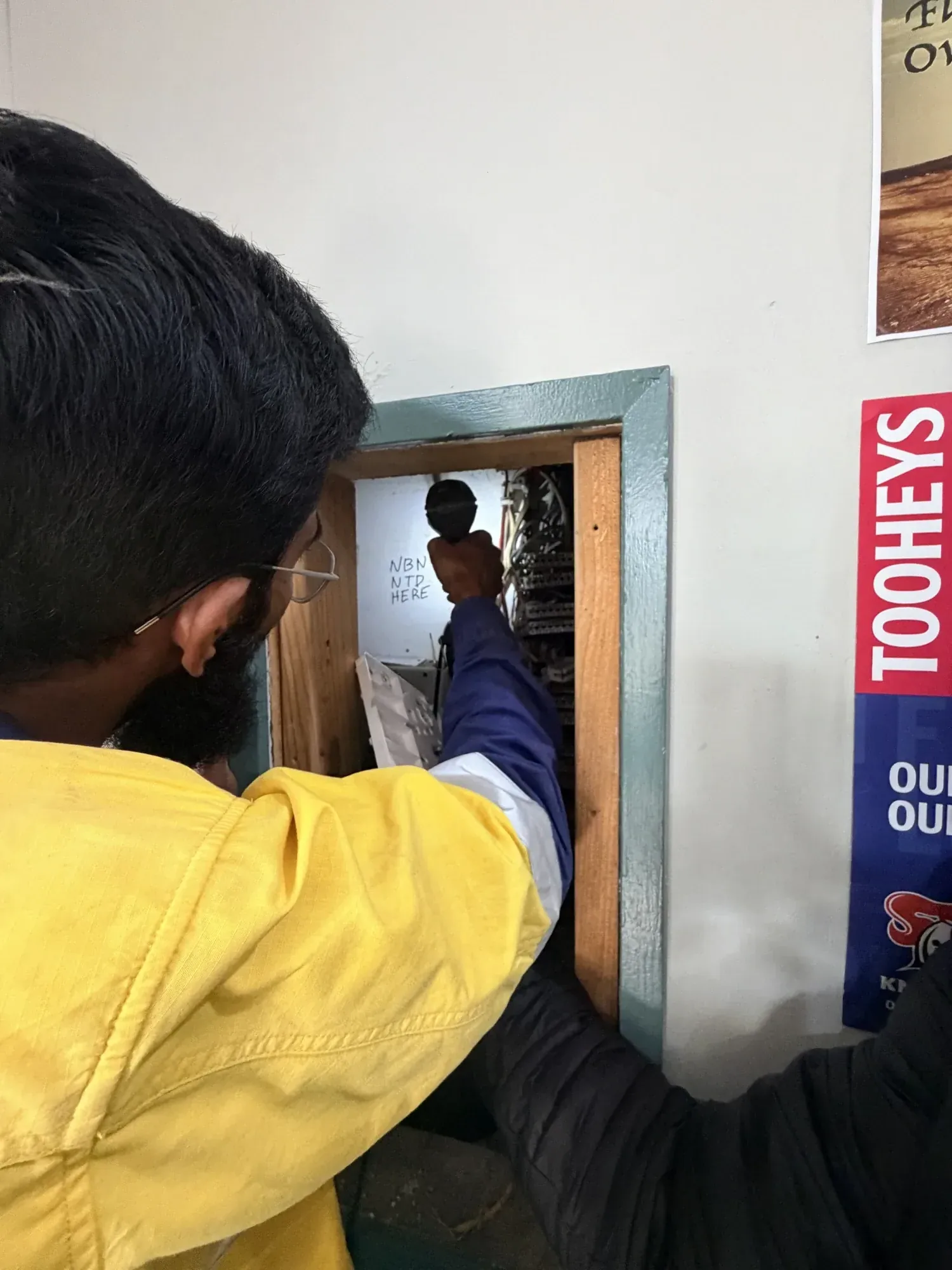
NBN Cabling, Socket Installation and Fault Repairs in Newcastle
Netlink's ACMA-registered cablers deliver NBN cabling Newcastle-wide — NBN internal cabling Newcastle homes and businesses rely on for NBN wiring repair, socket installation and relocation, bridge-tap removal, dedicated modem sockets and Cat6 between the NTD and router. We diagnose slow NBN and internet dropouts, fix damaged internal cable, and prepare homes for FTTP upgrades.
- ACMA-registered NBN cabler — customer-side wiring only
- Newcastle, Lake Macquarie, Maitland, Cessnock & Hunter
- Bridge-tap removal, NBN line repair & modem relocation
- New NBN socket installation & socket relocation
Netlink is an independent provider of customer-side telecommunications cabling — not an internet provider, not NBN Co and not an authorised NBN contractor. Network outages, damaged street infrastructure and faults within the external NBN network must be reported to your internet provider.
If any of these sound familiar, an NBN cabler visit is usually the fix.
- 01Provider reports an internal wiring fault
- 02Internet keeps dropping out
- 03Slow FTTN or FTTB connection
- 04Multiple old telephone sockets
- 05Damaged or poorly terminated internal cable
- 06Modem or router is in the wrong room
- 07Need a new NBN or modem socket
- 08Need Cat6 between the NTD and router
- 09Preparing for an FTTP upgrade
Request an NBN cabling assessment.
Tell us the suburb, the NBN technology (if you know it) and what's going wrong — attach a couple of photos of the wall sockets, NTD location or affected room and we'll come back with a fixed price for the diagnosis or repair.
- ACMA-registered cabler — customer-side wiring only
- Fixed price after site assessment
- Written fault report you can share with your provider
- Newcastle, Lake Macquarie, Maitland, Cessnock & Hunter
Customer-side NBN cabling completed by registered cablers.
Netlink assesses and provides the following customer-side telecommunications cabling services — everything on the internal side of the NBN network boundary.
- Internal telecommunications cabling fault diagnosis
- Bridge-tap identification and removal
- New or relocated telecommunications sockets
- Dedicated modem cabling
- NTD-to-router Ethernet cabling
- Modem and router relocation
- Cat6 cabling to granny flats and detached buildings
- FTTP internal pathway preparation
- Customer-side cabling for apartments and commercial premises
- Written fault reports
- Cabling compliance documentation where applicable
- Communications-rack and patch-panel connections
Who should the customer contact?
Not every NBN problem is a wiring problem. This table shows the best first contact for common scenarios.
| Problem | Best contact |
|---|---|
| Internet provider reports an internal wiring fault | ACMA-registered cabler |
| Bridge tap or several unused telephone sockets | ACMA-registered cabler |
| Need a new or relocated modem socket | ACMA-registered cabler |
| Need Ethernet between the NTD and router | ACMA-registered cabler |
| Need the modem or router in another room | ACMA-registered cabler |
| External NBN outage | Internet provider |
| Damage to a street pit, street cable or external NBN network | Internet provider or nbn |
| Red optical alarm light on an FTTP NTD | Internet provider |
| Need NBN-supplied equipment relocated | Site assessment under applicable nbn requirements |
NBN connection technologies
Each NBN technology uses different equipment and cabling, so the correct repair or relocation method depends on what is installed at the property. Netlink assesses the technology on-site before recommending a fix.
Fibre runs directly to the property and terminates at an NBN Connection Box (NTD) inside the building. Customer-side work centres on the router location, Ethernet from the NTD, and internal Cat6/Cat6A distribution.
Fibre reaches a node in the street; the last leg is copper to a wall socket. Bridge taps, unused telephone sockets and damaged internal cabling can noticeably affect VDSL performance.
Fibre reaches a communications room inside a multi-unit building; copper distributes to each unit. Customer-side work covers the in-unit socket and internal cabling only.
Fibre reaches a distribution point at the kerb; copper delivers the last few metres to a small NBN Connection Device inside the property. Internal socket quality and cable length matter.
Signal is delivered on the coaxial (Foxtel-style) network to a wall outlet and NBN Connection Box. Splitters, damaged coax and unused branches can affect performance.
Customers should not attempt to disconnect or alter NBN-supplied equipment themselves. Where NBN equipment must be moved, the work is assessed under the applicable nbn requirements.
Bridge taps and internal wiring faults
A bridge tap is an unused branch on the customer's internal telephone cabling — for example, a length of cable running from the first socket out to a second or third socket that is no longer used. Because the extra copper still sits on the line, it can create electrical reflections that degrade the connection between the street node and the modem.
Where it matters most
On FTTN and FTTB (VDSL) connections, bridge taps and other internal faults can be a significant factor in slow, inconsistent or dropping connections. On FTTP the line inside the home is a fibre link, so traditional bridge-tap effects do not apply — but internal socket damage and Ethernet cabling problems can still cause similar symptoms.
Common symptoms
- Slower than expected sync or throughput
- Frequent short dropouts, especially during rain
- Line noise, crackle or intermittent connection
- Provider reports the fault is on the customer side
- Speeds improved briefly after unplugging older phones or sockets
How a registered cabler tests the internal wiring
A registered cabler isolates each internal socket, checks continuity and insulation, identifies any unused branches, and where necessary uses telecommunications test equipment to locate faults on the internal line. On completion, we provide a written report of what was found and repaired — useful evidence for the customer's internet provider.
Possible repair options
- Remove unused sockets and dead branches from the internal line
- Re-terminate the first / lead-in socket
- Install a dedicated modem socket close to the router position
- Replace damaged internal cable sections
- Run new Cat6 to the preferred router location
Not every speed or connection issue is caused by internal wiring — some sit with the provider, the NBN network or the customer's equipment. The value of a professional assessment is knowing which of these it actually is, and having the evidence to prove it.
NTD and modem relocation
"Moving the NBN" usually means one of four different things — and picking the right one keeps cost down and avoids unnecessary work on NBN-supplied equipment.
Moving the NBN-supplied device itself. This is only done where permitted under applicable nbn requirements and may be referred back to the provider.
Often the simpler and cheaper solution. Ethernet is run from the NTD to a better router position elsewhere in the home or business.
A neat, permanent cable run through wall cavities or ceiling voids — no cables trailing along skirting boards.
Add mesh Wi-Fi, hardwired access points, or extra Ethernet outlets so coverage extends to the areas people actually use.
Registered cablers may alter certain NBN facilities only where permitted under the applicable nbn Authority to Alter requirements. Some work must still be referred to the customer's provider or nbn.
NBN wiring for granny flats and detached buildings
Where the main residence has an NBN service and a granny flat, workshop or shed also needs network access, there are several practical options — chosen based on the distance between buildings and the required speed.
- Cat6 or Cat6A between the buildings for short runs
- Fibre between separate buildings for longer distances or electrical isolation
- A local network switch in the second building
- One or more Wi-Fi access points to extend coverage
One NBN service cannot always be shared between separately addressed premises. Provider terms should be checked before permanently cross-connecting two properties.
For structured cabling work on either side of the property, Netlink also delivers residential data cabling, commercial cabling and fibre splicing & testing — all under the same site visit where practical.
Business NBN wiring
For offices, warehouses and commercial fit-outs, customer-side NBN wiring is one part of a broader network readiness picture — communications room, structured cabling, patch panels and Wi-Fi access points across the site.
- Communications-room preparation
- NTD-to-router or firewall cabling
- Communications racks
- Patch panels
- Internal network readiness
- Wi-Fi access points
- Pathway and power planning
- Minimising downtime during changeover
For businesses upgrading to NBN Enterprise Ethernet, see the dedicated NBN Business Site Readiness Audit page — customer-side MDU cabling and pathway preparation, subject to building approval and applicable nbn requirements.
How we deliver NBN wiring work.
Actual internet speed depends on the NBN technology, service plan, provider network, modem, Wi-Fi environment and connected devices — not on the internal cabling alone.
Dedicated NBN cabling pages for high-demand Newcastle & Lake Macquarie suburbs.
Local pages with the specific NBN technology mix, the common wiring faults Netlink sees on-site and a suburb-prefilled enquiry form.
Where Netlink completes NBN wiring
Netlink completes NBN wiring across Newcastle, Lake Macquarie, Maitland, Cessnock, Port Stephens, Dungog, Singleton, Muswellbrook and the wider Hunter region.
Factors affecting cost
Every NBN wiring job is priced against the actual property. The quote takes the following factors into account:
- Type of NBN connection
- Fault complexity
- Number of existing sockets
- Cable-route length
- Roof, underfloor and wall access
- Building construction
- Equipment relocation requirements
- New outlets
- Cat6 or fibre requirements
- Written reporting
- Regional travel
Customer-side NBN cabling completed by registered cablers.
Anonymised project examples — coming soon
Netlink is compiling a small set of anonymised recent NBN wiring jobs — suburb or general service area, property type, reported problem, testing performed, finding, and work completed or recommended outcome. Verified examples will be added here as they become available. No customer names or full addresses will ever be published.
Book a related service on the same visit
Roof, wall or pole-mounted Starlink with weather-sealed cable entry.
Cat6 outlets, wired Wi-Fi backhaul and home-office connections.
Fusion splicing and OTDR-tested fibre for commercial links.
NBN wiring FAQs
What does an NBN cabler repair?
An ACMA-registered NBN cabler repairs customer-side telecommunications wiring — internal cabling faults, bridge taps, damaged sockets, unused branches on the internal line, and cabling issues between the NBN Connection Box (NTD) and the modem or router. Faults in the external NBN network are handled by the internet provider.
What is a bridge tap?
A bridge tap is an unused branch on the customer's internal telephone cabling — typically a length of cable running to a socket that is no longer used. On FTTN or FTTB connections this can degrade VDSL performance. A registered cabler tests the internal cabling and removes unnecessary branches where appropriate.
Can Netlink move my NBN modem to another room?
Yes. In most cases the modem or router can be relocated by installing a new socket or by running Ethernet from the existing NBN Connection Box to a preferred position. The right approach depends on the NBN technology and property construction.
Do I need to move the NTD to improve Wi-Fi?
Usually not. Wi-Fi coverage is normally best addressed by relocating the router, adding Ethernet outlets in the areas that need coverage, or installing mesh Wi-Fi or hardwired access points. Moving the NTD itself is only necessary in some cases.
Who repairs an internal NBN wiring fault?
Internal wiring faults are customer-side and must be repaired by an ACMA-registered cabler. Providers such as Telstra, Optus, TPG, Aussie Broadband, Vodafone and others will refer this work to a private cabler once external network testing indicates the issue is on the customer side.
Can Netlink install a new NBN socket?
Yes. Netlink installs new or relocated telecommunications sockets, dedicated modem sockets and Cat6 outlets so the router can sit where the customer needs it.
Can you connect the NTD to a granny flat?
In many cases yes. Options include Cat6 or Cat6A between the buildings, fibre between separate buildings, a local network switch, or a Wi-Fi access point in the second building. Provider terms and applicable NBN requirements should be checked where a shared connection is planned.
What should I do if the fault is in the external NBN network?
Report the fault to your internet provider. External network faults, damaged street infrastructure, network outages and NBN-supplied equipment failures are handled by the provider and by nbn — not by a customer-side cabler.
Can a registered cabler relocate NBN equipment?
Registered cablers may alter certain NBN facilities where permitted under the applicable nbn Authority to Alter requirements. Some work must still be referred to the customer's internet provider or nbn.
How much does NBN wiring or fault finding cost?
Pricing depends on the type of NBN connection, fault complexity, number of existing sockets, cable-route length, roof / underfloor / wall access, building construction, equipment relocation needs, new outlets, Cat6 or fibre requirements, written reporting and regional travel. Request an assessment for a fixed price against your property.
If your internet is slow or Wi-Fi keeps dropping out, the fix isn't always new NBN wiring. Our Wi-Fi & internet troubleshooting service diagnoses whether the problem is customer-side cabling, router placement, Wi-Fi coverage — or a genuine provider fault worth escalating.
Request an NBN cabling assessment
Serving Newcastle, Lake Macquarie, Maitland, Cessnock, Port Stephens and the wider Hunter region.